
Many companies define their roadmaps for software projects on the basis of quarterly plans. It promises a structured path to achieving their goals, but how often does it truly deliver on its promise? This post dives into the mathematics of planning to understand why waterfall-style planning is often unsuccessful.
Consider the following scenario: Your team has 12 tasks to complete over the next quarter. You’re confident—there’s a 90% chance each task will be completed on time and within the desired quality. Sounds promising, right?
But here’s where it gets interesting. If we assume the success of each task is independent, the probability of all tasks succeeding is not 90% but dramatically lower. The power of compound probability explains why:
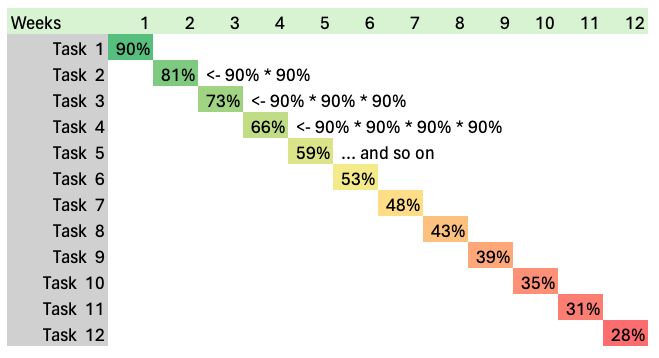
The math is straightforward: The chance of all 12 tasks being completed successfully is 90% to the power of 12, or roughly 28%. This stark drop from 90% to 28% unveils a critical oversight in many planning processes:
The failure to account for the compound effect of risk across multiple tasks.
Why shorter cycles win#
Shorter planning cycles solve this problem of uncertainty. Instead of betting on a full quarter, commit to fewer tasks in a smaller timeframe.
Let’s say we commit to 3–4 tasks over a couple of four weeks. The same 90% confidence per task now looks like this:
$0.9^4 = 0.66 \approx 66%$
Still not perfect, but 66% beats 28%! More importantly, you find out what went wrong early.
Fail fast and adapt A failed task surfaces quickly. You can re-scope, re-prioritize, or re-shape while there’s still runway. Quarterly plans bury problems until the final status report.
Compound learning, not risk. Each cycle sharpens your estimates. You learn which tasks take longer than expected, which dependencies introduce friction, and how much your team can realistically ship.
Rethinking the roadmap#
None of this means you should stop thinking beyond a cycle of two or four weeks. You still need a direction. Stakeholders still need visibility into what’s coming.
The fix isn’t abandoning long-term planning. It’s changing what you plan. Replace the fixed quarterly commitment with a prioritized backlog. That backlog is your roadmap. It shows where you’re headed without locking you into a fixed timeline that probability will fail.
To burn through that backlog, pick an agile methodology that fits your team:
- Scrum works well for teams that benefit from structured ceremonies and fixed-length sprints
- Kanban suits teams with unpredictable work intake, a need for continuous flowm, or many individual contributors
- ShapeUp offers six-week cycles with two-week cooldowns, giving more room for deep work while still forcing regular reassessment
The methodology matters less than the principle: commit to small batches, deliver frequently, fail fast and adjust based on what you learn.